banner


Mathematical Proof By Induction Pdf

  1. Introduction
    1. Logical Reasoning
    2. Notation
  2. Methods of Proof
    1. Constructive Proof
    2. Proof by Contrapositive
    3. Proof by Contradiction
    4. Proof by Induction
    5. Counterexamples
  • Appendix
    • Answer Key
    • Symbols Used in this Book
    • Glossary

The beauty of induction is that it allows a theorem to be proven true where an infinite number of cases exist without exploring each case individually. Induction is analogous to an infinite row of dominoes with each domino standing on its end. If you want to make all the dominoes fall, you can either:

  1. push on the first one, wait to see what happens, and then check each domino afterwards (which may take a long time if there's an infinite number of dominoes!)
  2. or you can prove that if any domino falls, then it will cause the domino after it to fall. (i.e. if the first one falls then the second one will fall, and if the second one falls then the third one will fall, etc.)

Induction, essentially, is the methodology outlined in point 2.

Parts of Induction [edit | edit source]

Induction is composed of three parts:

  1. The Base Case (in the domino analogy, this shows the first domino will fall)
  2. The Induction Hypothesis (in the domino analogy, we assume that a particular domino will fall)
  3. The Inductive Step (in the domino analogy, we prove that the domino we assume will fall will cause the next domino to fall)

Weak Induction [edit | edit source]

Weak induction is used to show that a given property holds for all members of a countable inductive set, this usually is used for the set of natural numbers.

Weak induction for proving a statement P ( n ) {\displaystyle P(n)} (that depends on n {\displaystyle n} ) relies on two steps:

If these two properties hold, one may induce that the property holds for all elements in the set in question. Returning to the example, if you are sure that you called your neighbor, and you knew that everyone who was called in turn called his/her neighbor, then you would be guaranteed that everyone on the block had been called (assuming you had a linear block, or that it curved around nicely).

Examples [edit | edit source]

The first example of a proof by induction is always 'the sum of the first n terms:'

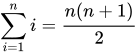
Theorem 2.4.1. For any fixed n N , {\displaystyle n\in \mathbb {N} ,} i = 1 n i = n ( n + 1 ) 2 {\displaystyle \sum _{i=1}^{n}{i}={\frac {n(n+1)}{2}}}
Proof
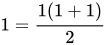
  • Base step: 1 = 1 2 2 {\displaystyle 1={\frac {1\cdot 2}{2}}} , therefore the base case holds.
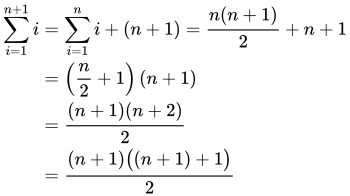
i = 1 n + 1 i = i = 1 n i + ( n + 1 ) = n ( n + 1 ) 2 + n + 1 = ( n 2 + 1 ) ( n + 1 ) = ( n + 1 ) ( n + 2 ) 2 = ( n + 1 ) ( ( n + 1 ) + 1 ) 2 {\displaystyle {\begin{aligned}\sum _{i=1}^{n+1}i&=\sum _{i=1}^{n}i+(n+1)={\frac {n(n+1)}{2}}+n+1\\&=\left({\frac {n}{2}}+1\right)(n+1)\\&={\frac {(n+1)(n+2)}{2}}\\&={\frac {(n+1){\big (}(n+1)+1{\big )}}{2}}\end{aligned}}}

So the inductive case holds. Now by induction we see that the theorem is true.

Reverse Induction [edit | edit source]

Reverse induction is a method of using an inductive step that uses a negative in the inductive step. It is a minor variant of weak induction. The process still applies only to countable sets, generally the set of whole numbers or integers, and will frequently stop at 1 or 0, rather than working for all positive numbers.

Reverse induction works in the following case.

  • The property holds for a given value, say M {\displaystyle M} .

Then the property holds for all values n M {\displaystyle n\leq M} .

Reverse induction is also usable in the general case [1]: "to establish the validity of a sequence of propositions P ( n ) ( n 1 ) {\displaystyle P(n)\ (n\geq 1)} , it is enough to establish the following

(a) P ( n ) {\displaystyle P(n)} is valid for infinitely many n {\displaystyle n} .

(b) If P ( n + 1 ) {\displaystyle P(n+1)} is valid, then so is P ( n ) {\displaystyle P(n)} .

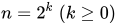
It can be the case that we can easily prove P ( 1 ) {\displaystyle P(1)} and if P {\displaystyle P} for n = m {\displaystyle n=m} so P {\displaystyle P} for n = 2 m {\displaystyle n=2m} . In this case we have (a) for the infinitely many n = 2 k ( k 0 ) {\displaystyle n=2^{k}\ (k\geq 0)} .
Strong Induction [edit | edit source]

In weak induction, for the inductive step, we only required that for a given n {\displaystyle n} , its immediate predecessor n 1 {\displaystyle n-1} satisfies the theorem (i.e., P ( n 1 ) {\displaystyle P(n-1)} is true). In strong induction, we require that not only the immediate predecessor, but all predecessors of n {\displaystyle n} satisfy the theorem. The variation in the inductive step is:

The reason this is called strong induction is fairly obvious — the hypothesis in the inductive step is much stronger than the hypothesis is in the case of weak induction. Of course, for finite induction it turns out to be the same hypothesis, but in the case of transfinite sets, weak induction is not even well-defined, since some sets have elements that do not have an immediate predecessor.

Transfinite Induction [edit | edit source]

Used in proving theorems involving transfinite cardinals. This technique is used in set theory to prove properties of cardinals, since there is rarely another way to go about it.

Inductive Set [edit | edit source]

We first define the notion of a well-ordered set. A set X {\displaystyle X} is well-ordered if there is a total order < {\displaystyle <} on X {\displaystyle X} and that whenever Y X {\displaystyle Y\subset X} is non-empty, there is a least-element in Y {\displaystyle Y} . That is, p Y {\displaystyle \exists p\in Y} such that p < q q Y {\displaystyle p<q\ \forall q\in Y} .

An inductive set is a set A X {\displaystyle A\subset X} such that the following hold:

  1. α A {\displaystyle \alpha \in A} (where α {\displaystyle \alpha } is the least element of X {\displaystyle X} )
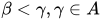
  2. If β A {\displaystyle \beta \in A} then γ X {\displaystyle \forall \gamma \in X} such that β < γ , γ A {\displaystyle \beta <\gamma ,\gamma \in A}

Of course, you look at that and say "Wait a minute. That means that A = X {\displaystyle A=X} !" And, of course you'd be right. That's exactly why induction works. The principle of induction is the theorem that says:

Theorem 2.4.2. If X {\displaystyle X} is a non-empty well-ordered set and A X {\displaystyle A\subset X} is an inductive subset of X {\displaystyle X} then A = X {\displaystyle A=X} .

The proof of this theorem is left as a very simple exercise. Here we note that the set of natural numbers is clearly well-ordered with the normal order that you are familiar with, so N {\displaystyle \mathbb {N} } is an inductive set. If you accept the axiom of choice, then it follows that every set can be well-ordered.

Exercises [edit | edit source]

Prove for every positive integer: 1 + + n = n ( n + 1 ) 2 {\displaystyle 1+\cdots +n={\frac {n(n+1)}{2}}}
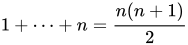
First, we show that it holds for n = 1 {\displaystyle n=1} .

1 = 1 ( 1 + 1 ) 2 {\displaystyle 1={\frac {1(1+1)}{2}}}

Suppose the identiy holds for some number n = k {\displaystyle n=k} , then

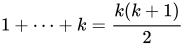
1 + + k = k ( k + 1 ) 2 {\displaystyle 1+\cdots +k={\frac {k(k+1)}{2}}}

We aim to show that

1 + + ( k + 1 ) = ( k + 1 ) ( k + 2 ) 2 {\displaystyle 1+\cdots +(k+1)={\frac {(k+1)(k+2)}{2}}}

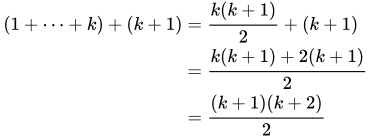
it follows that

( 1 + + k ) + ( k + 1 ) = k ( k + 1 ) 2 + ( k + 1 ) = k ( k + 1 ) + 2 ( k + 1 ) 2 = ( k + 1 ) ( k + 2 ) 2 {\displaystyle {\begin{aligned}(1+\cdots +k)+(k+1)&={\frac {k(k+1)}{2}}+(k+1)\\&={\frac {k(k+1)+2(k+1)}{2}}\\&={\frac {(k+1)(k+2)}{2}}\end{aligned}}}

which is what we have set out to show. Since the identity holds for 1, it also holds for 2 and since it holds for 3 and so on.

Prove for every positive integer: 1 2 + + n 2 = n ( n + 1 ) ( 2 n + 1 ) 6 {\displaystyle 1^{2}+\cdots +n^{2}={\frac {n(n+1)(2n+1)}{6}}}

First, we show that this statement holds for n = 1 {\displaystyle n=1} .

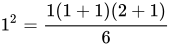
1 2 = 1 ( 1 + 1 ) ( 2 + 1 ) 6 {\displaystyle 1^{2}={\frac {1(1+1)(2+1)}{6}}}

Assume that the equation holds for n = k {\displaystyle n=k} . Then,

1 2 + + k 2 = k ( k + 1 ) ( 2 k + 1 ) 6 {\displaystyle 1^{2}+\cdots +k^{2}={\frac {k(k+1)(2k+1)}{6}}}

We aim to show that

1 2 + + ( k + 1 ) 2 = ( k + 1 ) ( k + 2 ) ( 2 k + 3 ) 6 {\displaystyle 1^{2}+\cdots +(k+1)^{2}={\frac {(k+1)(k+2)(2k+3)}{6}}}

it follows that

( 1 2 + + k 2 ) + ( k + 1 ) 2 = k ( k + 1 ) ( 2 k + 1 ) 6 + ( k + 1 ) 2 = k ( k + 1 ) ( 2 k + 1 ) + 6 ( k + 1 ) 2 6 = ( k + 1 ) [ k ( 2 k + 1 ) + 6 ( k + 1 ) ] 6 = ( k + 1 ) ( 2 k 2 + k + 6 k + 6 ) 6 = ( k + 1 ) ( 2 k 2 + 7 k + 6 ) 6 = ( k + 1 ) ( k + 2 ) ( 2 k + 3 ) 6 {\displaystyle {\begin{aligned}(1^{2}+\cdots +k^{2})+(k+1)^{2}&={\frac {k(k+1)(2k+1)}{6}}+(k+1)^{2}\\&={\frac {k(k+1)(2k+1)+6(k+1)^{2}}{6}}\\&={\frac {(k+1){\big [}k(2k+1)+6(k+1){\big ]}}{6}}\\&={\frac {(k+1)(2k^{2}+k+6k+6)}{6}}\\&={\frac {(k+1)(2k^{2}+7k+6)}{6}}\\&={\frac {(k+1)(k+2)(2k+3)}{6}}\end{aligned}}}

which is what we set out to prove. By mathematical induction, the formula holds for all positive integers.

Prove for every positive integer: 1 3 + + n 3 = ( n ( n + 1 ) 2 ) 2 {\displaystyle 1^{3}+\cdots +n^{3}=\left({\frac {n(n+1)}{2}}\right)^{2}}
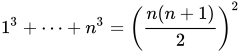
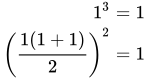
First, we show that this statement holds for n = 1 {\displaystyle n=1} .

1 3 = 1 ( 1 ( 1 + 1 ) 2 ) 2 = 1 {\displaystyle {\begin{aligned}1^{3}=1\\\left({\frac {1(1+1)}{2}}\right)^{2}=1\end{aligned}}}

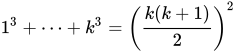
Suppose it's true for n = k {\displaystyle n=k} . Then,

1 3 + + k 3 = ( k ( k + 1 ) 2 ) 2 {\displaystyle 1^{3}+\cdots +k^{3}=\left({\frac {k(k+1)}{2}}\right)^{2}}

it follows that

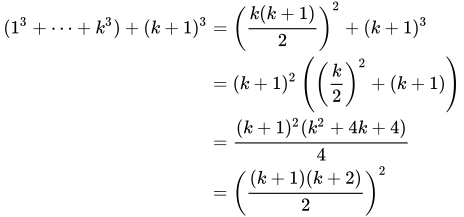
( 1 3 + + k 3 ) + ( k + 1 ) 3 = ( k ( k + 1 ) 2 ) 2 + ( k + 1 ) 3 = ( k + 1 ) 2 ( ( k 2 ) 2 + ( k + 1 ) ) = ( k + 1 ) 2 ( k 2 + 4 k + 4 ) 4 = ( ( k + 1 ) ( k + 2 ) 2 ) 2 {\displaystyle {\begin{aligned}(1^{3}+\cdots +k^{3})+(k+1)^{3}&=\left({\frac {k(k+1)}{2}}\right)^{2}+(k+1)^{3}\\&=(k+1)^{2}\left(\left({\frac {k}{2}}\right)^{2}+(k+1)\right)\\&={\frac {(k+1)^{2}(k^{2}+4k+4)}{4}}\\&=\left({\frac {(k+1)(k+2)}{2}}\right)^{2}\end{aligned}}}

We have shown that if it's true for n = k {\displaystyle n=k} then it's also true for n = k + 1 {\displaystyle n=k+1} . Now it's true for 1 (clear). Therefore it's true for all integers.

Show that n ! > 2 n {\displaystyle n!>2^{n}} for n 4 {\displaystyle n\geq 4}

The claim is true for n = 4 {\displaystyle n=4} .

4 ! > 2 4 24 > 16 {\displaystyle 4!>2^{4}\ \Rightarrow \ 24>16}

Now suppose it's true for n = k 4 {\displaystyle n=k\geq 4} . Then,

k ! > 2 k {\displaystyle k!>2^{k}}

it follows that

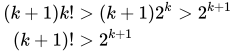
( k + 1 ) k ! > ( k + 1 ) 2 k > 2 k + 1 ( k + 1 ) ! > 2 k + 1 {\displaystyle {\begin{aligned}(k+1)k!&>(k+1)2^{k}>2^{k+1}\\(k+1)!&>2^{k+1}\end{aligned}}}

We have shown that if for n = k {\displaystyle n=k} then it's also true for n = k + 1 {\displaystyle n=k+1} . Since it's true for 4 , it's true for all integers n 4 {\displaystyle n\geq 4} .

Prove for every positive integer: 2 + 4 + 6 + + 2 n = n ( n + 1 ) {\displaystyle 2+4+6+\cdots +2n=n(n+1)}

First, we show that this statement holds for n = 1 {\displaystyle n=1} .

2 = 1 ( 1 + 1 ) {\displaystyle 2=1(1+1)}

Assume that the equation holds for n = k {\displaystyle n=k} . Then,

2 + 4 + 6 + + 2 k = k ( k + 1 ) {\displaystyle 2+4+6+\cdots +2k=k(k+1)}

We aim to show that

2 + 4 + 6 + + 2 ( k + 1 ) = ( k + 1 ) ( k + 2 ) {\displaystyle 2+4+6+\cdots +2(k+1)=(k+1)(k+2)}

it follows that

( 2 + 4 + 6 + + 2 k ) + 2 ( k + 1 ) = k ( k + 1 ) + 2 ( k + 1 ) = ( k + 1 ) ( k + 2 ) {\displaystyle {\begin{aligned}(2+4+6+\cdots +2k)+2(k+1)&=k(k+1)+2(k+1)\\&=(k+1)(k+2)\end{aligned}}}

which is what we set out to prove. By mathematical induction, the formula holds for all positive integers.

Prove for every positive integer: 1 + 4 + 7 + + ( 3 n 2 ) = n ( 3 n 1 ) 2 {\displaystyle 1+4+7+\cdots +(3n-2)={\frac {n(3n-1)}{2}}}

First, we show that this statement holds for n = 1 {\displaystyle n=1} .

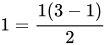
1 = 1 ( 3 1 ) 2 {\displaystyle 1={\frac {1(3-1)}{2}}}

Assume that the equation holds for n = k {\displaystyle n=k} . Then,

1 + 4 + 7 + + ( 3 k 2 ) = k ( 3 k 1 ) 2 {\displaystyle 1+4+7+\cdots +(3k-2)={\frac {k(3k-1)}{2}}}

We aim to show that

1 + 4 + 7 + + ( 3 ( k + 1 ) 2 ) = ( k + 1 ) ( 3 k + 2 ) 2 {\displaystyle 1+4+7+\cdots +{\bigl (}3(k+1)-2{\bigr )}={\frac {(k+1)(3k+2)}{2}}}

it follows that

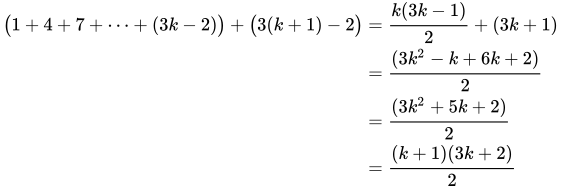
( 1 + 4 + 7 + + ( 3 k 2 ) ) + ( 3 ( k + 1 ) 2 ) = k ( 3 k 1 ) 2 + ( 3 k + 1 ) = ( 3 k 2 k + 6 k + 2 ) 2 = ( 3 k 2 + 5 k + 2 ) 2 = ( k + 1 ) ( 3 k + 2 ) 2 {\displaystyle {\begin{aligned}{\big (}1+4+7+\cdots +(3k-2){\big )}+{\big (}3(k+1)-2{\big )}&={\frac {k(3k-1)}{2}}+(3k+1)\\&={\frac {(3k^{2}-k+6k+2)}{2}}\\&={\frac {(3k^{2}+5k+2)}{2}}\\&={\frac {(k+1)(3k+2)}{2}}\end{aligned}}}

which is what we set out to prove. By mathematical induction, the formula holds for all positive integers.

Prove for every positive integer: 2 + 7 + 12 + + ( 5 n 3 ) = n ( 5 n 1 ) 2 {\displaystyle 2+7+12+\cdots +(5n-3)={\frac {n(5n-1)}{2}}}

First, we show that this statement holds for n = 1 {\displaystyle n=1} .

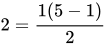
2 = 1 ( 5 1 ) 2 {\displaystyle 2={\frac {1(5-1)}{2}}}

Assume that the equation holds for n = k {\displaystyle n=k} . Then,

2 + 7 + 12 + + ( 5 k 3 ) = k ( 5 k 1 ) 2 {\displaystyle 2+7+12+\cdots +(5k-3)={\frac {k(5k-1)}{2}}}

We aim to show that

2 + 7 + 12 + + ( 5 ( k + 1 ) 3 ) = ( k + 1 ) ( 5 ( k + 1 ) 1 ) 2 {\displaystyle 2+7+12+\cdots +{\bigl (}5(k+1)-3{\bigr )}={\frac {(k+1){\bigl (}5(k+1)-1{\bigr )}}{2}}}

it follows that

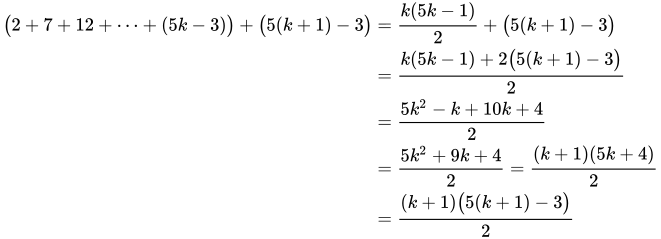
( 2 + 7 + 12 + + ( 5 k 3 ) ) + ( 5 ( k + 1 ) 3 ) = k ( 5 k 1 ) 2 + ( 5 ( k + 1 ) 3 ) = k ( 5 k 1 ) + 2 ( 5 ( k + 1 ) 3 ) 2 = 5 k 2 k + 10 k + 4 2 = 5 k 2 + 9 k + 4 2 = ( k + 1 ) ( 5 k + 4 ) 2 = ( k + 1 ) ( 5 ( k + 1 ) 3 ) 2 {\displaystyle {\begin{aligned}{\big (}2+7+12+\cdots +(5k-3){\big )}+{\big (}5(k+1)-3{\big )}&={\frac {k(5k-1)}{2}}+{\big (}5(k+1)-3{\big )}\\&={\frac {k(5k-1)+2{\big (}5(k+1)-3{\big )}}{2}}\\&={\frac {5k^{2}-k+10k+4}{2}}\\&={\frac {5k^{2}+9k+4}{2}}={\frac {(k+1)(5k+4)}{2}}\\&={\frac {(k+1){\bigl (}5(k+1)-3{\bigr )}}{2}}\end{aligned}}}

which is what we set out to prove. By mathematical induction, the formula holds for all positive integers.

Prove for every positive integer: 1 + 2 2 + 2 2 3 + + 2 n 1 n = 2 n ( n 1 ) + 1 {\displaystyle 1+2\cdot 2+2^{2}\cdot 3+\cdots +2^{n-1}n=2^{n}(n-1)+1}

First, we show that this statement holds for n = 1 {\displaystyle n=1} .

1 = 2 1 ( 1 1 ) + 1 {\displaystyle 1=2^{1}(1-1)+1}

Assume that the equation holds for n = k {\displaystyle n=k} . Then,

1 + 2 2 + 2 2 3 + + 2 k 1 k = 2 k ( k 1 ) + 1 {\displaystyle 1+2\cdot 2+2^{2}\cdot 3+\cdots +2^{k-1}k=2^{k}(k-1)+1}

We aim to show that

1 + 2 2 + 2 2 3 + + 2 k ( k + 1 ) = 2 k + 1 k + 1 {\displaystyle 1+2\cdot 2+2^{2}\cdot 3+\cdots +2^{k}(k+1)=2^{k+1}k+1}

it follows that

( 1 + 2 2 + 2 2 3 + + 2 k 1 k ) + 2 k ( k + 1 ) = 2 k ( k 1 ) + 1 + 2 k ( k + 1 ) = 2 k ( k + 1 + k 1 ) + 1 = 2 k ( 2 k ) + 1 = 2 k + 1 k + 1 {\displaystyle {\begin{aligned}(1+2\cdot 2+2^{2}\cdot 3+\cdots +2^{k-1}k)+2^{k}(k+1)&=2^{k}(k-1)+1+2^{k}(k+1)\\&=2^{k}(k+1+k-1)+1\\&=2^{k}(2k)+1\\&=2^{k+1}k+1\end{aligned}}}

which is what we set out to prove. By mathematical induction, the formula holds for all positive integers.

Prove for every positive integer: 1 1 2 + + 1 n ( n + 1 ) = n n + 1 {\displaystyle {\frac {1}{1\cdot 2}}+\cdots +{\frac {1}{n(n+1)}}={\frac {n}{n+1}}}

First, we show that this statement holds for n = 1 {\displaystyle n=1} .

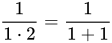
1 1 2 = 1 1 + 1 {\displaystyle {\frac {1}{1\cdot 2}}={\frac {1}{1+1}}}

Assume that the equation holds for n = k {\displaystyle n=k} . Then,

1 1 2 + + 1 k ( k + 1 ) = k k + 1 {\displaystyle {\frac {1}{1\cdot 2}}+\cdots +{\frac {1}{k(k+1)}}={\frac {k}{k+1}}}

We aim to show that

1 1 2 + + 1 ( k + 1 ) ( k + 2 ) = k + 1 k + 2 {\displaystyle {\frac {1}{1\cdot 2}}+\cdots +{\frac {1}{(k+1)(k+2)}}={\frac {k+1}{k+2}}}

it follows that

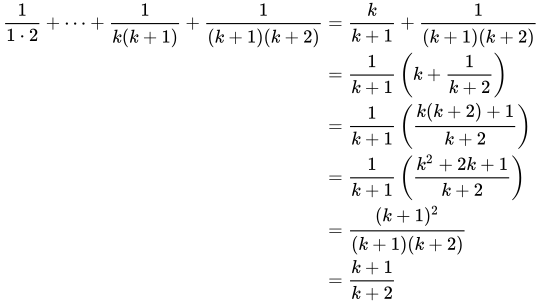
1 1 2 + + 1 k ( k + 1 ) + 1 ( k + 1 ) ( k + 2 ) = k k + 1 + 1 ( k + 1 ) ( k + 2 ) = 1 k + 1 ( k + 1 k + 2 ) = 1 k + 1 ( k ( k + 2 ) + 1 k + 2 ) = 1 k + 1 ( k 2 + 2 k + 1 k + 2 ) = ( k + 1 ) 2 ( k + 1 ) ( k + 2 ) = k + 1 k + 2 {\displaystyle {\begin{aligned}{\frac {1}{1\cdot 2}}+\cdots +{\frac {1}{k(k+1)}}+{\frac {1}{(k+1)(k+2)}}&={\frac {k}{k+1}}+{\frac {1}{(k+1)(k+2)}}\\&={\frac {1}{k+1}}\left(k+{\frac {1}{k+2}}\right)\\&={\frac {1}{k+1}}\left({\frac {k(k+2)+1}{k+2}}\right)\\&={\frac {1}{k+1}}\left({\frac {k^{2}+2k+1}{k+2}}\right)\\&={\frac {(k+1)^{2}}{(k+1)(k+2)}}\\&={\frac {k+1}{k+2}}\end{aligned}}}

which is what we set out to prove. By mathematical induction, the formula holds for all positive integers.

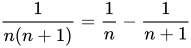
This problem can be solved without mathematical induction. We note that

1 n ( n + 1 ) = 1 n 1 n + 1 {\displaystyle {\frac {1}{n(n+1)}}={\frac {1}{n}}-{\frac {1}{n+1}}}

Then, the question can be paraphrased as

1 1 1 2 + 1 2 1 3 + + 1 n 1 1 n + 1 n 1 n + 1 = n n + 1 {\displaystyle {\frac {1}{1}}-{\frac {1}{2}}+{\frac {1}{2}}-{\frac {1}{3}}+\cdots +{\frac {1}{n-1}}-{\frac {1}{n}}+{\frac {1}{n}}-{\frac {1}{n+1}}={\frac {n}{n+1}}}

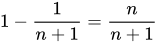
which simplfies to

1 1 n + 1 = n n + 1 {\displaystyle 1-{\frac {1}{n+1}}={\frac {n}{n+1}}}

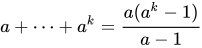
Prove for every positive integer: a + + a n = a ( a n 1 ) a 1 : a 0 {\displaystyle a+\cdots +a^{n}={\frac {a(a^{n}-1)}{a-1}}:a\neq 0}

First, we show that this statement holds for n = 1 {\displaystyle n=1} .

a = a ( a 1 1 ) a 1 {\displaystyle a={\frac {a(a^{1}-1)}{a-1}}}

Assume that the equation holds for n = k {\displaystyle n=k} . Then,

a + + a k = a ( a k 1 ) a 1 {\displaystyle a+\cdots +a^{k}={\frac {a(a^{k}-1)}{a-1}}}

We aim to show that

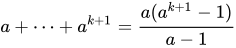
a + + a k + 1 = a ( a k + 1 1 ) a 1 {\displaystyle a+\cdots +a^{k+1}={\frac {a(a^{k+1}-1)}{a-1}}}

it follows that

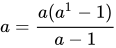
( a + + a k ) + a k + 1 = a ( a k 1 ) a 1 + a k + 1 = a ( a k 1 ) + a k + 1 ( a 1 ) a 1 = a [ a k 1 + a k ( a 1 ) ] a 1 = a [ a k 1 + a a k a k ] a 1 = a ( a k + 1 1 ) a 1 {\displaystyle {\begin{aligned}(a+\cdots +a^{k})+a^{k+1}&={\frac {a(a^{k}-1)}{a-1}}+a^{k+1}\\&={\frac {a(a^{k}-1)+a^{k+1}(a-1)}{a-1}}\\&={\frac {a{\big [}a^{k}-1+a^{k}(a-1){\big ]}}{a-1}}\\&={\frac {a{\big [}a^{k}-1+a\cdot a^{k}-a^{k}{\big ]}}{a-1}}\\&={\frac {a(a^{k+1}-1)}{a-1}}\end{aligned}}}

which is what we set out to prove. By mathematical induction, the formula holds for all positive integers.

This can also be proven using the sum formula for a geometric series.

Prove for every positive integer: ( 1 + + n 5 ) + ( 1 + + n 7 ) = 2 ( n ( n + 1 ) 2 ) 4 {\displaystyle (1+\cdots +n^{5})+(1+\cdots +n^{7})=2\left({\frac {n(n+1)}{2}}\right)^{4}}

First, we show that this statement holds for n = 1 {\displaystyle n=1} .

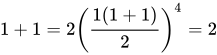
1 + 1 = 2 ( 1 ( 1 + 1 ) 2 ) 4 = 2 {\displaystyle 1+1=2\left({\frac {1(1+1)}{2}}\right)^{4}=2}

Assume that the equation holds for n = k {\displaystyle n=k} . Then,

( 1 + + k 5 ) + ( 1 + + k 7 ) = 2 ( k ( k + 1 ) 2 ) 4 {\displaystyle (1+\cdots +k^{5})+(1+\cdots +k^{7})=2\left({\frac {k(k+1)}{2}}\right)^{4}}

We aim to show that

( 1 + + ( k + 1 ) 5 ) + ( 1 + + ( k + 1 ) 7 ) = 2 ( ( k + 1 ) ( k + 2 ) 2 ) 4 {\displaystyle {\bigl (}1+\cdots +(k+1)^{5}{\bigr )}+{\bigl (}1+\cdots +(k+1)^{7}{\bigr )}=2\left({\frac {(k+1)(k+2)}{2}}\right)^{4}}

it follows that

( 1 + + k 5 ) + ( k + 1 ) 5 + ( 1 + + k 7 ) + ( k + 1 ) 7 = 2 ( k ( k + 1 ) 2 ) 4 + ( k + 1 ) 5 + ( k + 1 ) 7 = ( k + 1 ) 4 [ k 4 + 8 ( k + 1 ) + 8 ( k + 1 ) 3 ] 8 = ( k + 1 ) 4 [ k 4 + 8 ( k + 1 ) ( 1 + ( k + 1 ) 2 ) ] 8 = ( k + 1 ) 4 [ k 4 + 8 ( k + 1 ) ( k 2 + 2 k + 2 ) ] 8 = ( k + 1 ) 4 ( k 4 + 8 k 3 + 24 k 2 + 32 k + 16 ) 8 = ( k + 1 ) 4 ( k + 2 ) 4 8 = 2 ( ( k + 1 ) ( k + 2 ) 2 ) 4 {\displaystyle {\begin{aligned}(1+\cdots +k^{5})+(k+1)^{5}+(1+\cdots +k^{7})+(k+1)^{7}&=2\left({\frac {k(k+1)}{2}}\right)^{4}+(k+1)^{5}+(k+1)^{7}\\&={\frac {(k+1)^{4}{\big [}k^{4}+8(k+1)+8(k+1)^{3}{\big ]}}{8}}\\&={\frac {(k+1)^{4}{\big [}k^{4}+8(k+1){\big (}1+(k+1)^{2}{\big )}{\big ]}}{8}}\\&={\frac {(k+1)^{4}{\big [}k^{4}+8(k+1)(k^{2}+2k+2){\big ]}}{8}}\\&={\frac {(k+1)^{4}(k^{4}+8k^{3}+24k^{2}+32k+16)}{8}}\\&={\frac {(k+1)^{4}(k+2)^{4}}{8}}\\&=2\left({\frac {(k+1)(k+2)}{2}}\right)^{4}\end{aligned}}}

which is what we set out to prove. By mathematical induction, the formula holds for all positive integers.

Prove for every positive integer: ( 1 + x ) n 1 + n x : x 1 {\displaystyle (1+x)^{n}\geq 1+nx:x\geq -1} (the so called Bernoulli's inequality)

First, we show that this statement holds for n = 1 {\displaystyle n=1} .

( 1 + x ) 1 1 + x {\displaystyle (1+x)^{1}\geq 1+x} because ( 1 + x ) 1 = 1 + 1 x {\displaystyle (1+x)^{1}=1+1\cdot x}

Assume that the equation holds for n = k {\displaystyle n=k} . Then,

( 1 + x ) k 1 + k x {\displaystyle (1+x)^{k}\geq 1+kx}

We aim to show that

( 1 + x ) k + 1 1 + ( k + 1 ) x {\displaystyle (1+x)^{k+1}\geq 1+(k+1)x}

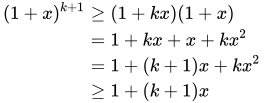
Multyplying ( 1 + x ) {\displaystyle (1+x)} by both sides, (desn't alter the sign of the inequality because x 1 {\displaystyle x\geq -1} , and so x + 1 0 {\displaystyle x+1\geq 0} )

( 1 + x ) k + 1 ( 1 + k x ) ( 1 + x ) = 1 + k x + x + k x 2 = 1 + ( k + 1 ) x + k x 2 1 + ( k + 1 ) x {\displaystyle {\begin{aligned}(1+x)^{k+1}&\geq (1+kx)(1+x)\\&=1+kx+x+kx^{2}\\&=1+(k+1)x+kx^{2}\\&\geq 1+(k+1)x\end{aligned}}}

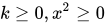
The last step relies on the fact that k x 2 0 {\displaystyle kx^{2}\geq 0} , since k 0 , x 2 0 {\displaystyle k\geq 0,x^{2}\geq 0} .

By mathematical induction, the formula holds for all positive integers.

Prove for every positive integer: 1 3 + + ( n 1 ) 3 < n 4 4 < 1 3 + + n 3 {\displaystyle 1^{3}+\cdots +(n-1)^{3}<{\frac {n^{4}}{4}}<1^{3}+\cdots +n^{3}}
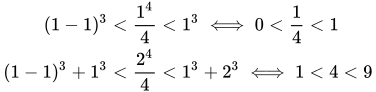
First, we show that this statement holds for n = 1 , 2 {\displaystyle n=1,2} .

( 1 1 ) 3 < 1 4 4 < 1 3 0 < 1 4 < 1 ( 1 1 ) 3 + 1 3 < 2 4 4 < 1 3 + 2 3 1 < 4 < 9 {\displaystyle {\begin{aligned}(1-1)^{3}&<{\frac {1^{4}}{4}}<1^{3}\iff 0<{\frac {1}{4}}<1\\(1-1)^{3}+1^{3}&<{\frac {2^{4}}{4}}<1^{3}+2^{3}\iff 1<4<9\end{aligned}}}

Assume that the inequality holds for n = k {\displaystyle n=k} . Then,

1 3 + + ( k 1 ) 3 < k 4 4 < 1 3 + + k 3 {\displaystyle 1^{3}+\cdots +(k-1)^{3}<{\frac {k^{4}}{4}}<1^{3}+\cdots +k^{3}}

We aim to show that

1 3 + + k 3 < ( k + 1 ) 4 4 < 1 3 + + ( k + 1 ) 3 {\displaystyle 1^{3}+\cdots +k^{3}<{\frac {(k+1)^{4}}{4}}<1^{3}+\cdots +(k+1)^{3}}

We know that

( 1 3 + + ( k 1 ) 3 ) + k 3 < k 4 4 + k 3 {\displaystyle {\bigl (}1^{3}+\cdots +(k-1)^{3}{\bigr )}+k^{3}<{\frac {k^{4}}{4}}+k^{3}}

Now we need to show that

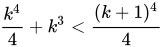
k 4 4 + k 3 < ( k + 1 ) 4 4 {\displaystyle {\frac {k^{4}}{4}}+k^{3}<{\frac {(k+1)^{4}}{4}}}

it follows that

k 4 4 + k 3 < ( k + 1 ) 4 4 k 3 ( k + 1 ) 4 < k 4 + 4 k 3 + 6 k 2 + 4 k + 1 4 0 < 6 k 2 + 4 k + 1 4 {\displaystyle {\begin{aligned}{\frac {k^{4}}{4}}+k^{3}<{\frac {(k+1)^{4}}{4}}&\iff {\frac {k^{3}(k+1)}{4}}<{\frac {k^{4}+4k^{3}+6k^{2}+4k+1}{4}}\\&\iff 0<{\frac {6k^{2}+4k+1}{4}}\end{aligned}}}

The last statement is clearly true ( k > 0 {\displaystyle k>0} ). Therefore,

1 3 + + k 3 < k 4 4 + k 3 < ( k + 1 ) 4 4 {\displaystyle 1^{3}+\cdots +k^{3}<{\frac {k^{4}}{4}}+k^{3}<{\frac {(k+1)^{4}}{4}}}

Now we show that

( k + 1 ) 4 4 < 1 3 + + ( k + 1 ) 3 {\displaystyle {\frac {(k+1)^{4}}{4}}<1^{3}+\cdots +(k+1)^{3}}

We know that

k 4 4 + ( k + 1 ) 3 < ( 1 3 + + k 3 ) + ( k + 1 ) 3 {\displaystyle {\frac {k^{4}}{4}}+(k+1)^{3}<(1^{3}+\cdots +k^{3})+(k+1)^{3}}

Now we need to show that

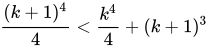
( k + 1 ) 4 4 < k 4 4 + ( k + 1 ) 3 {\displaystyle {\frac {(k+1)^{4}}{4}}<{\frac {k^{4}}{4}}+(k+1)^{3}}

it follows that

( k + 1 ) 4 4 < k 4 4 + ( k + 1 ) 3 k 4 + 4 k 3 + 6 k 2 + 4 k + 1 4 < k 4 + 4 ( k 3 + 3 k 2 + 3 k + 1 ) 4 k 4 + 4 k 3 + 6 k 2 + 4 k + 1 4 < k 4 + 4 k 3 + 12 k 2 + 12 k + 4 4 0 < 6 k 2 + 8 k + 3 4 {\displaystyle {\begin{aligned}{\frac {(k+1)^{4}}{4}}<{\frac {k^{4}}{4}}+(k+1)^{3}&\iff {\frac {k^{4}+4k^{3}+6k^{2}+4k+1}{4}}<{\frac {k^{4}+4(k^{3}+3k^{2}+3k+1)}{4}}\\&\iff {\frac {k^{4}+4k^{3}+6k^{2}+4k+1}{4}}<{\frac {k^{4}+4k^{3}+12k^{2}+12k+4}{4}}\\&\iff 0<{\frac {6k^{2}+8k+3}{4}}\end{aligned}}}

The last statement is clearly true ( k > 0 {\displaystyle k>0} ). Therefore,

( k + 1 ) 4 4 < 1 3 + + ( k + 1 ) 3 {\displaystyle {\frac {(k+1)^{4}}{4}}<1^{3}+\cdots +(k+1)^{3}}

Combining both inequalities we proved, we get the one we needed for the inductive step.

1 3 + + k 3 < ( k + 1 ) 4 4 < 1 3 + + ( k + 1 ) 3 {\displaystyle 1^{3}+\cdots +k^{3}<{\frac {(k+1)^{4}}{4}}<1^{3}+\cdots +(k+1)^{3}}

and by mathematical induction, the formula holds for all positive integers.

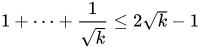
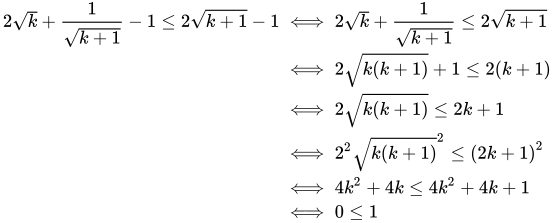
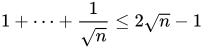
Prove for every positive integer: 1 + + 1 n 2 n 1 {\displaystyle 1+\cdots +{\frac {1}{\sqrt {n}}}\leq 2{\sqrt {n}}-1} (Hard)

First, we show that this statement holds for n = 1 {\displaystyle n=1} .

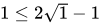
1 2 1 1 {\displaystyle 1\leq 2{\sqrt {1}}-1} because 1 1 {\displaystyle 1\leq 1}

Assume that the inequality holds for n = k {\displaystyle n=k} . Then,

1 + + 1 k 2 k 1 {\displaystyle 1+\cdots +{\frac {1}{\sqrt {k}}}\leq 2{\sqrt {k}}-1}

We aim to show that

1 + + 1 k + 1 2 k + 1 1 {\displaystyle 1+\cdots +{\frac {1}{\sqrt {k+1}}}\leq 2{\sqrt {k+1}}-1}

We know that

( 1 + + 1 k ) + 1 k + 1 2 k + 1 k + 1 1 {\displaystyle \left(1+\cdots +{\frac {1}{\sqrt {k}}}\right)+{\frac {1}{\sqrt {k+1}}}\leq 2{\sqrt {k}}+{\frac {1}{\sqrt {k+1}}}-1}

Now we need to show that

2 k + 1 k + 1 1 2 k + 1 1 {\displaystyle 2{\sqrt {k}}+{\frac {1}{\sqrt {k+1}}}-1\leq 2{\sqrt {k+1}}-1}

it follows that

2 k + 1 k + 1 1 2 k + 1 1 2 k + 1 k + 1 2 k + 1 2 k ( k + 1 ) + 1 2 ( k + 1 ) 2 k ( k + 1 ) 2 k + 1 2 2 k ( k + 1 ) 2 ( 2 k + 1 ) 2 4 k 2 + 4 k 4 k 2 + 4 k + 1 0 1 {\displaystyle {\begin{aligned}2{\sqrt {k}}+{\frac {1}{\sqrt {k+1}}}-1\leq 2{\sqrt {k+1}}-1&\iff 2{\sqrt {k}}+{\frac {1}{\sqrt {k+1}}}\leq 2{\sqrt {k+1}}\\&\iff 2{\sqrt {k(k+1)}}+1\leq 2(k+1)\\&\iff 2{\sqrt {k(k+1)}}\leq 2k+1\\&\iff 2^{2}{\sqrt {k(k+1)}}^{2}\leq {(2k+1)}^{2}\\&\iff 4k^{2}+4k\leq 4k^{2}+4k+1\\&\iff 0\leq 1\end{aligned}}}

The last statement is clearly true. Therefore,

1 + + 1 k + 1 k + 1 2 k + 1 k + 1 1 2 k + 1 1 {\displaystyle 1+\cdots +{\frac {1}{\sqrt {k}}}+{\frac {1}{\sqrt {k+1}}}\leq 2{\sqrt {k}}+{\frac {1}{\sqrt {k+1}}}-1\leq 2{\sqrt {k+1}}-1}

and by mathematical induction, the formula holds for all positive integers.

Prove for every positive integer: 3 is a factor of n 3 n + 3 {\displaystyle n^{3}-n+3}

First, we show that this statement is true for n = 1 {\displaystyle n=1} . For n = 1 {\displaystyle n=1}

1 3 1 + 3 = 3 {\displaystyle 1^{3}-1+3=3} , and 3 is a factor of 3.

Since we have shown the base case to be true, we assume that the statement is true for n = k {\displaystyle n=k} where k Z + {\displaystyle k\in \mathbb {Z^{+}} } .

k 3 k + 3 = 3 w {\displaystyle k^{3}-k+3=3w} where w Z + {\displaystyle w\in \mathbb {Z^{+}} } (in other words, the expression is divisible by 3 for any positive integer).

Given that the base case was true for n = 1 {\displaystyle n=1} and the statement is assumed to be true for n = k {\displaystyle n=k} , it must also be true for n = k + 1 {\displaystyle n=k+1} which we attempt to prove now:

3 z = ( k + 1 ) 3 ( k + 1 ) + 3 = k 3 + 3 k 2 + 3 k + 1 k 1 + 3 = [ k 3 k + 3 ] + 3 k 2 + 3 k = 3 w + 3 k 2 + 3 k = 3 ( w + k 2 + k ) z = w + k 2 + k {\displaystyle {\begin{aligned}3z&=(k+1)^{3}-(k+1)+3\\&=k^{3}+3k^{2}+3k+1-k-1+3\\&=[k^{3}-k+3]+3k^{2}+3k\\&=3w+3k^{2}+3k\\&=3(w+k^{2}+k)\\z&=w+k^{2}+k\end{aligned}}}

Therefore, the statement is true for n = k + 1 {\displaystyle n=k+1} based on the assumption that n = k {\displaystyle n=k} is true, and so by mathematical induction, the statement is true for all positive integers.

Prove for every positive integer: 9 is a factor of 10 n + 1 + 3 10 n + 5 {\displaystyle 10^{n+1}+3\cdot 10^{n}+5}

No Solutions Available

Prove for every positive integer: 4 is a factor of 5 n 1 {\displaystyle 5^{n}-1}

First we show that this statement holds for n = 1 , 2 {\displaystyle n=1,2} . For n=1,

5 1 1 = 4 {\displaystyle 5^{1}-1=4} , and 4 is a factor of 4.

For n=2,

5 2 1 = 24 {\displaystyle 5^{2}-1=24} , and 4 is a factor of 24.

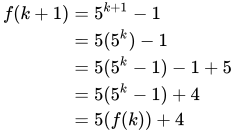
Therefore, the base case holds. Now we assume that the equation above, f ( n ) {\displaystyle f(n)} holds for n=k, and attempt to prove that the equation holds for n=k+1.

f ( k + 1 ) = 5 k + 1 1 = 5 ( 5 k ) 1 = 5 ( 5 k 1 ) 1 + 5 = 5 ( 5 k 1 ) + 4 = 5 ( f ( k ) ) + 4 {\displaystyle {\begin{aligned}f(k+1)&=5^{k+1}-1\\&=5(5^{k})-1\\&=5(5^{k}-1)-1+5\\&=5(5^{k}-1)+4\\&=5(f(k))+4\end{aligned}}}

By our inductive hypothesis above, 4 is a factor of f(k), and 4 is a factor of 4, so we know that 4 must also be a factor of 5 ( f ( k ) ) + 4 {\displaystyle 5(f(k))+4} . By mathematical induction, this equation holds for all positive integers.

Prove for every positive integer: x y {\displaystyle x-y} is a factor of x n y n {\displaystyle x^{n}-y^{n}}

No Solutions Available

Prove for every positive integer: 2304 is a factor of 7 2 n 48 n 1 {\displaystyle 7^{2n}-48n-1}
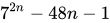
No Solutions Available

References [edit | edit source]

  1. http://people.math.carleton.ca/~ckfong/hs14a.pdf

Mathematical Proof By Induction Pdf

Source: https://en.wikibooks.org/wiki/Mathematical_Proof/Methods_of_Proof/Proof_by_Induction

Posted by: suggsopme1984.blogspot.com

0 Response to "Mathematical Proof By Induction Pdf"

Post a Comment

Iklan Atas Artikel

Iklan Tengah Artikel 1

Iklan Tengah Artikel 2

Iklan Bawah Artikel