

How To Draw An Anime Background
Manga and Anime Week Having struggled my mode through this myself, I'd like to share some advice and my thoughts on budgeted more complex backgrounds or how to starting time.
In my feel, backgrounds are often seen as difficult and/or challenging, especially past beginning artists, and many tend to avert complex ones in the beginning. A mix of scary technical terms such as 'perspective', 'composition', 'lighting', 'values' and so forth is frequently associated with them, which can easily seem overwhelming. And, since backgrounds can sometimes very much be considered equally pieces of art on their own; they requires essentially equally many diverse skills as drawing annihilation else.
1. Types of backgrounds
Offset of all, information technology's important to note thata background doesn't take to be an incredibly realistic detailed painted landscape to exist considered 'good' or 'astonishing' even.Depending on what you're going for, fifty-fifty a monotonous or abstract groundwork can have a great impact! Information technology can be very powerful to residual groovy detail (in your foreground, actress objects, characters. and then on) with simplicity, like in the examples below
Other themes that are oft used for more complex backgrounds are nature, landscapes, cityscapes, skies, rooms, buildings, and many more than. Different types of backgrounds can require unlike skills, for case, cityscapes are oft more demanding when it comes to perspective, while nature may require better rendering skills. Nonetheless, there are things that are skillful to know for all types of backgrounds, then let'southward have a look!
2. Inspiration and ideas
I often have a general idea of what I want to do with the background if I start on an artwork, but it's hard to work from that solitary. That's why I like to take inspiration from all kinds of resources; pictures I detect online or that I have taken myself, work from other artists, and so along, and have folders on my estimator where I store images that I observe interesting. Sites such as Pinterest tin can also be really helpful for browsing for inspiration and storing images you like! You tin can mix and combine images that fit your ideas or inspire you and make a collage.

Example of how some of my inspiration images accept influenced
the concluding groundwork in In Nomine Iustitia.
If you're really stuck for inspiration, enquire yourself some questions. What suits your bailiwick? Are there objects easily associated with your character? Are there symbols that you would like to include? And remember, as seen above, a good background doesn't accept to be all that complex, either.
Don't be agape to apply references. This applies to all aspects of your artwork; if they're available, apply them! It's very hard to make a background wait believable just from memory or imagination lonely, particularly when information technology comes to rendering. A quick Google search volition often already find you lot some good reference images if you're stuck.
Of form, it is important that you are responsible with your apply of references and resources. Especially when taking inspiration from the works of other artists, be aware of the divergence betwixt taking inspiration from a certain artwork you like or blatantly copying concepts or backgrounds in obvious means. If you lot look at the example in a higher place, I have taken the idea of a small round gazebo in the groundwork, simply I did not direct copy the blueprint. When you heavily reference a resource, don't forget todon't forget credit the original when you submit online.
3. Where to start
If you have enough inspiration simply are really at a loss when it comes to where to start, it might exist useful for y'all to start out with a few thumbnails. Thumbnails are small-scale sketches that tin can exist as rough as you like, simply are meant to exam out a few ideas chop-chop, from which you tin pick the all-time and base the main sketch on that tumbnail.

If yous've picked out a good thumbnail, you tin can commencement on laying out the main features of the background.Preparing your background is simply equally important every bit the main subject of your fine art, especially with complex backgrounds, but yous can arroyo it in different ways. Some like to sketch out and and so use clean linework for the background, others continue it more loose and sketchy, and I personally like the 'digital painting' arroyo.

I like to start my backgrounds past roughly laying out objects, shapes and colours,
and for more than detailed parts I'll add a sketch commencement.
When you're in this phase, don't attach yourself likewise much just all the same and don't be afraid to play around with limerick. Your kickoff thought is not ever the best, and some small adjustments like enlarging an object, moving it to the left or to the correct, or even deforming it slightly tin all take a big effect.
4. The power of suggestion
(also known as 'clever laziness')
I would like to address this as a separate point from anything else I am going to say in this commodity, because in my stance this is one of the most of import things to know when it comes to fine art, specially in the case of backgrounds.
One of the most powerful tools for an artist is being able to speak to the imagination of the viewer. Oftentimes, a suggestion of an object can be enough for the viewer to 'complete the scene' for themselves, with picayune attempt of the creative person. Human being brains are well-trained in recognizing patterns based on their experiences, and as an artist, you should try and have advantage of this!
For example, imagine you want to draw a castle in the groundwork of your fine art. You could spent a lot of fourth dimension and endeavor designing and drawing an entire castle in the correct perspective with all kinds of modest details such as the individual bricks of the castle.This would take an eternity, and you might feel demotivated to continue halfway through because it's then much tedious piece of work and the composition ends up far also strong for your liking.Another arroyo you could take is the following; instead of designing and cartoon the unabridged castle, you could just include 1 or two of the castle towers in the background and the viewer volition imagine the rest of the castle attached to these towers. Or, you could include the silhouette of the castle in the far distance of a mural.
Am I saying that beingness lazy all the fourth dimension is a good matter? Probably not, and you lot should definitely claiming yourself from time to fourth dimension in order to meliorate. However, be lazy in a smart way and exist reasonable nearly what you can and cannot achieve at your current level.Endeavor to guess decisively if something is worth the time you're spending on it, or if you could reach the same (or fifty-fifty better!) effect by choosing something simpler. You don't have to be a perfect expert on the beefcake or details of animals, plants, buildings and then forth. Y'all tin can add in vague shapes in the background, and almost people will still be able to recognize them equally flowers/plants, and and then forth, without them being fully rendered, similar in the examples below.
:origin()/pre00/61f3/th/pre/f/2017/344/a/e/fgo_salem_by_sishenfan-dbwb8f5.jpg)


(works past shishenfan, robotfish, alchemaniac)
Using and mastering these types of 'lazy' techniques doesn't make you less of an artist. I would rather debate, that if y'all know how to use this well plenty, you have become amelioratecreative person. If y'all know the implications of leaving things vague, such as creating depth or changing the principal focus of your work, you tin can utilize them to your advantage. Depending on the mode and message yous're going for, photo-realism is perhaps non the nigh important aspect of an artwork, especially in an era where we carry portable cameras around everywhere and can take a picture show of any we like at any time. While photography is an art of its own, what is your interpretation of the object/graphic symbol/scene?
In other words, you lot don't even have to be an expert on landscapes, foliage, perspective, buildings, etc. to come up up with a good background! Don't hesitate to experiment!
5. Building on your sketch
Now you've laid out the base and learned how suggestion tin be a powerful tool, it's time to transform your idea into a final production. I of the reasons that you shouldn't get too attached to the sketch, or shouldn't exist disappointed if the sketch doesn't look as spectacular equally you had imagined it, is that it is a base of operations, and not a final product. Creating backgrounds is a process, with learning moments, sudden ideas and revelations, struggles, problems and solutions.
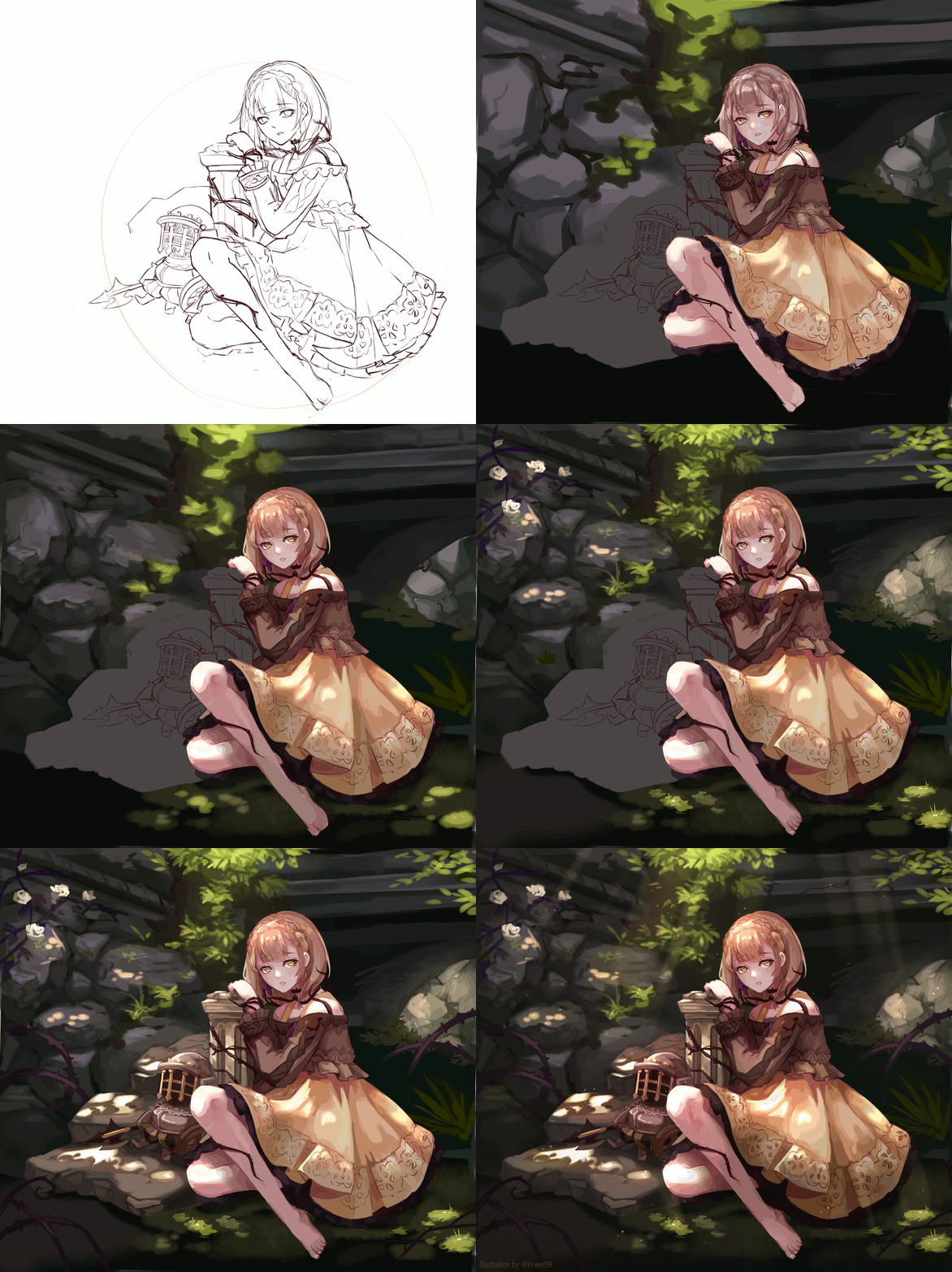
Process gif of Cursed Slumber
Lite and Shadow, Depth
The part that brings your background to life the almost is adding depth through light and shadow. Go on in mind the low-cal source that acts on the character and think about how it will affect the objects in the background. Add highlights and shadows accordingly, and your background volition instantly expect more '3D'.

The flames in the foreground cast lite on the edge of the clock in the background.
The clockwork inside is by and large shielded by the foremost parts of the clock, thus
appears darker.
Rendering
Rendering refers to paying attending to textures and structures of objects. Remember those references you gathered at the start? Now is the time to use them! (And probably find out you don't have enough and accept to find more than :'D ) While you've figured out the general calorie-free and dark areas previously, it is now time to think virtually how certain materials interact with light. For case, some surfaces like metal are very shiny, while some fabrics or untreated wood react to low-cal in a very unlike fashion. If you're not certain, look up some more references and/or tutorials! The more practice you get with this, the easier it volition become.
And again, recollect about the power of suggestion. The viewer probably has a good idea of what the grass y'all're drawing should expect similar, but more than chiefly, the viewer knows what it shouldn't look like, as well. It'due south more pleasing to the centre if something is left more up to proffer, than defined in an incorrect or unnatural way.
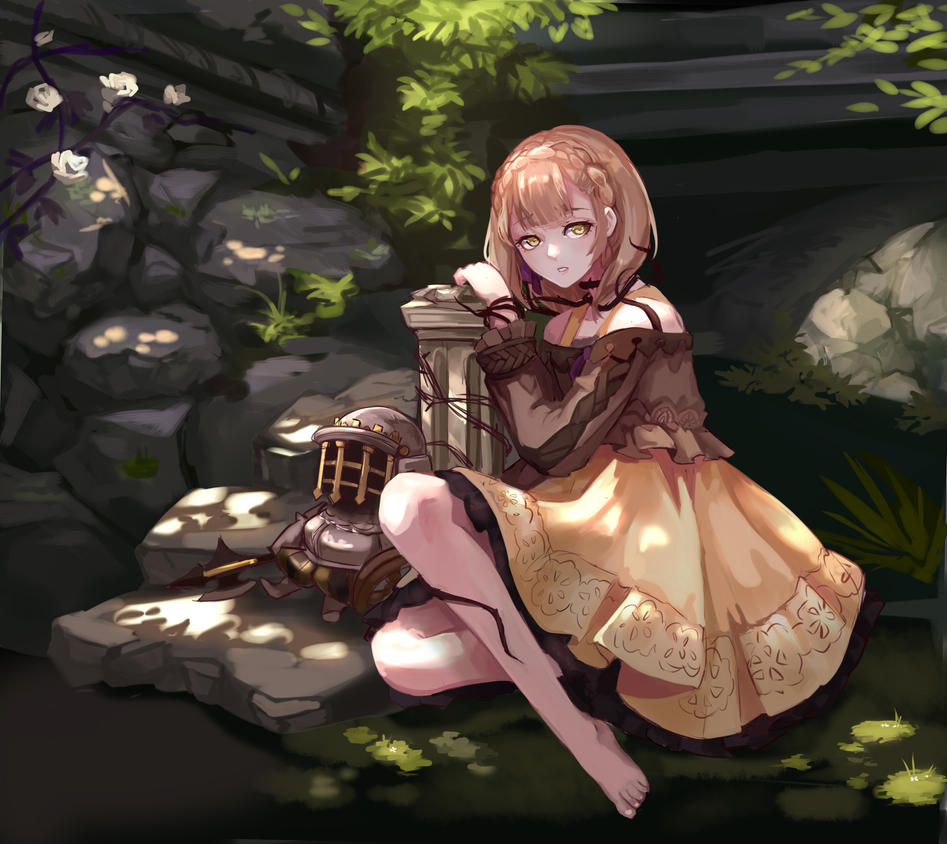
By adding lighting and more than detailed shapes, the shapes in the first images announced more like rock or leaves.
half dozen. Immersing the character(s) in the scene
What I discover with a lot of artists (including myself), peculiarly in the anime/manga style, is that they (used to) consider a background every bit an 'addition' to their artwork; something y'all add at the end. As a outcome, information technology sometimes looks like the principal subject area of the cartoon, for example the character, is merely 'pasted on top' of a background, instead of actually beingness part of the environs. In some cases, particularly with simpler backgrounds such as colours and patterns, it'south okay to add them at the end, but with more detailed ones, it is very important to think about it as a slice of the illustration that might be equally important as the discipline (such equally a character).
This part is about how to go far await like your subject area or graphic symbol is actually a part of the surround in the groundwork, instead of 'pasted on top of information technology'. There are many ways you can achieve this, and many technical aspects behind this. For the sake of the length of this article, I will not go likewise deep into technicalities, but if you would like to know more almost a certain attribute, do non hesitate to look upward more tutorials on the topic! There are enough of expert resource out there~
Light
Lighting can often be a very strong, if not the near of import, factor in making it conceivable that your grapheme is part of the environment instead of but in front of it. Try to make sure that the light is coming from the same management with both the character and objects in the background (unless you have multiple calorie-free sources). If there are light sources nowadays in the groundwork, remember almost how they will affect your subject and the highlights and shadows casted on it.


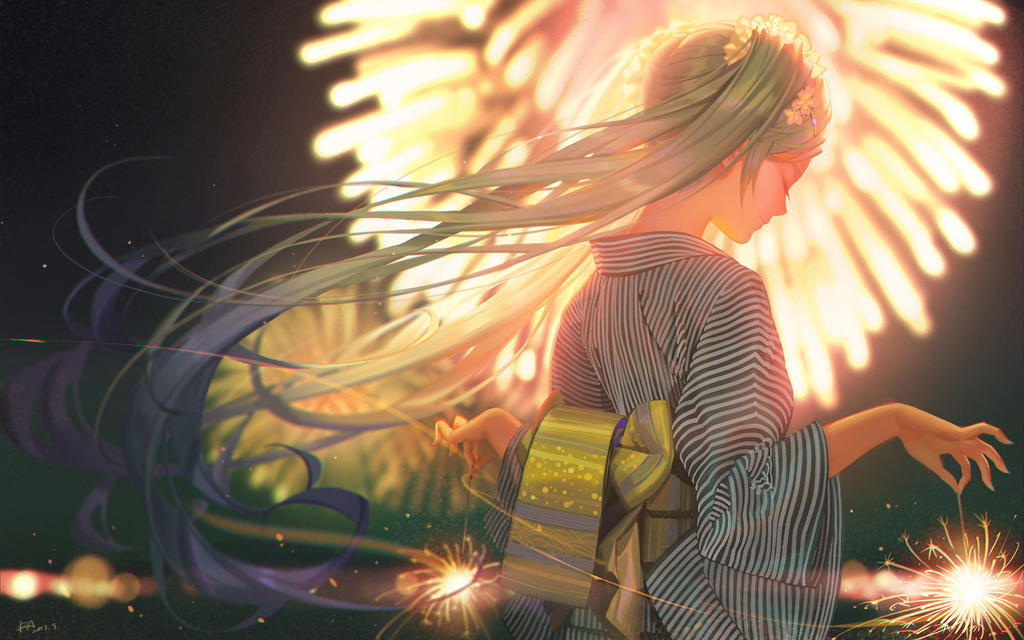
(works by observerz, jayuu, ra-lilium)
Adding a foreground
I know this commodity was about backgrounds, but... aren't foregrounds essentially part of the background besides?! Another easy way to immerse your character into the scene is throughsuggesting the background continues all around the character, which can be washed with a foreground.
Dynamic composition
A dynamic composition does not simply make your work more interesting, only can too help immersing your character in the groundwork through showing that your graphic symbol interacts with/has an bear on on the groundwork. Eg. if your character is a fire mage, yous can add together magic furnishings, only as well show burning houses/copse in the groundwork.
Small tricks that can add dynamism to your work:
- Instead of having the horizon perfectly directly, slightly tilting it in the direction of motion or contrary to the direction of motion
- Having elements of your groundwork follow move lines (ofttimes used with clouds/skies, flames, magic effects, for case)
- Tilting perspective in the direction of motion
- Emphasizing certain areas with lighting
Values, enhancing the character
Since we already established that our brains are lazy and that they are focused on recognizing patterns, it's important to make a scene piece of cake to read. The easiest mode to do this is to make sure that the grapheme has a clear silhouette against the background, and this tin exist done by creating a contrast in values. Values essentially refer to the lightness/darkness of a colour, without taking hue into account. In other words; think of your image equally if it were in greyscale. Here are two quick tricks to bank check your values/the readability of the scene;
1. If yous zoom out very far, and look at the thumbnail version of your piece, is information technology however
articulate what the chief features of your character are? (i.e. overall body shape, face, etc.)
2. If you alter the settings to greyscale, is your character however conspicuously visible
confronting the background? Do the lighter/darker values make your character stand autonomously
enough to distinguish them from the background?

7. Finishing touches
This function varies per artist, only most have their own final touches for backgrounds and/or their artworks to add together that last touch on. These are some final effects you could add together and how you tin can utilize them to heighten your artwork!
Blurs
Using a blur to the background tin can assistance add depth and/or motion to your piece! By blurring certain areas of the background, yous can also guide the middle of the viewer; they volition automatically focus on the not blurred parts, and pay less attention to the blurred parts. You can add together depth by blurring parts that are further away or really shut to the 'camera', and leaving the subject untouched, or movement by blurring the edges of moving objects. If using this event, it's helpful to remember about the way blur works in photographs to make information technology wait natural! Some examples of how artists accept incorporated blurs in different ways:


![[Blade And Soul Art Competition] Pohwaran by iorlvm](https://pre00.deviantart.net/f5d7/th/pre/i/2014/224/c/9/_blade_and_soul_art_competition__pohwaran_by_iorlvm-d7uy8fl.jpg)
Glows and calorie-free effects
Like blurring, adding glows to objects can assist guide the viewer's eye. This type of upshot can vary from glowing orbs or shapes to add together 'magic issue' or overall glows on an object. Glow effects can be really squeamish, but information technology's piece of cake to overuse them. Try to use them to improve the readability of your artwork/background, instead of decreasing it. Some other light effects that are ordinarily used are sparkles and lens flares, I like to use them to accentuate that ane item in either the foreground or the groundwork. Again, be conscientious not to overuse them!


:origin()/pre00/6919/th/pre/i/2014/037/7/3/stocking__by_dahllange-d75biud.jpg)
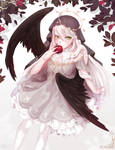
Some artists choose to heighten their paradigm through giving information technology a texture, such every bit watercolour and/or paper textures, film grain and dissonance. Contrasting textures also assist to enhance sure parts of the work and propose unlike materials.

In this work pastkidchan, the artist has made use of a texture to enhance the face up and the hair of the character, while too integrating her in the background by letting the texture cover her apparel, as well.
eight. Improving
The best advice I can requite you when it comes to backgrounds is; just start. They might seem complicated and scary at first, but if you never start, you'll never better on them, either.
Something that tin can help a lot in terms of improving on backgrounds is doing some studies from real life, from fourth dimension to time, even if you draw in a stylized style similar anime/manga. By looking at references, you'll pick up useful practice with lighting, composition, and rendering of objects, and of course stylized styles are always to some extent based on reality! Fifty-fifty if your report ends up not looking like your reference at the get-go, there's always something that you have learned.


Examples of photo studies I've done myself
Furthermore, now you know the ins an outs of backgrounds, you can report your favourite artists and just why their backgrounds work then well! It never hurts to try and incorporate that in your own piece of work... Thank you for reading this commodity! I hope this has been useful, and that you take learned something new! If yous accept whatsoever questions, please don't hesitate to inquire me.
As I mentioned at the start, backgrounds are artworks of their own, and require just as a complex skill set every bit creating an unabridged piece. So at the start, of course it's overwhelming to work with very detailed and complex backgrounds, and of grade it's okay to get like shooting fish in a barrel on yourself from time to time as well. Simply the skillful news on the other mitt is that as you meliorate as an artist, yous'll automatically ameliorate on backgrounds, as well!



Source: https://www.deviantart.com/kirwet99/journal/How-to-Background-A-Guide-720496679
Posted by: suggsopme1984.blogspot.com
0 Response to "How To Draw An Anime Background"
Post a Comment